


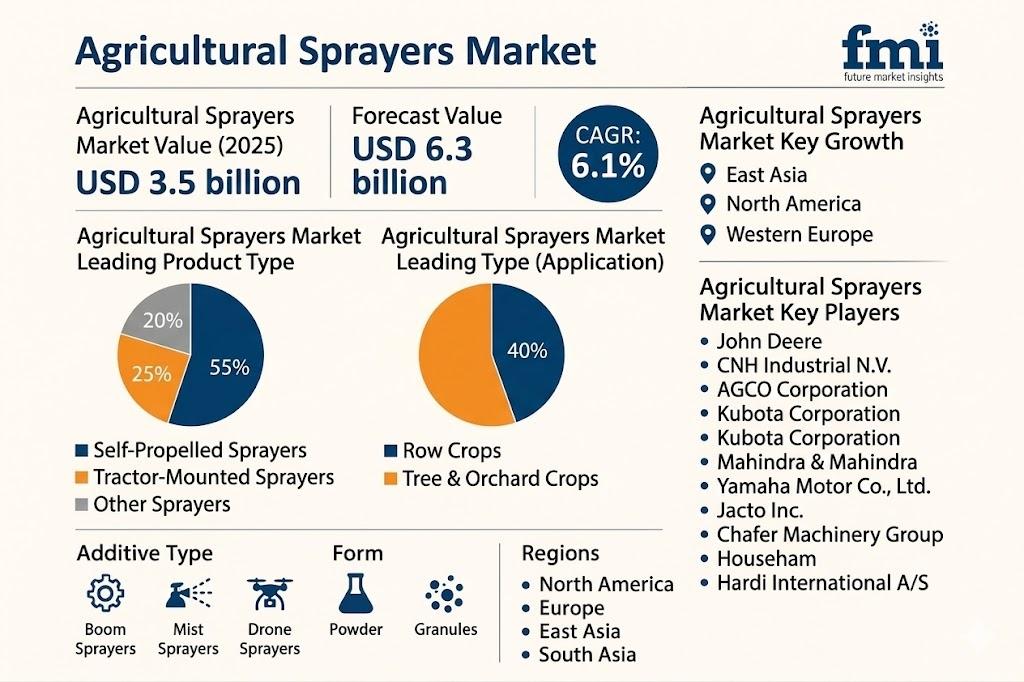
the global agricultural sprayers market is entering a phase of measured yet resilient expansion, driven by the increasing need for precision agriculture, optimized chemical usage, and improved crop yield efficiency. According to FMI, the market is projected to grow from USD 3,689.1 million in 2026 to USD 6,544.3 million by 2036, registering a CAGR of 5.9%.
This growth reflects a USD 2,855.2 million incremental opportunity, with the market expanding nearly 1.8X over the forecast period. Rather than disruptive transformation, the industry is evolving through gradual technology adoption, replacement demand, and performance-driven equipment upgrades.
Get detailed market forecasts, competitive benchmarking, and pricing trends: https://www.futuremarketinsights.com/reports/sample/rep-gb-1366
Featured Snippet
- Market Size (2026): USD 3,689.1 million
- Forecast Value (2036): USD 6,544.3 million
- CAGR (2026–2036): 5.9%
- Key Growth Driver: Precision agrochemical application & mechanization
- Top Segment: Handheld sprayers (33.2% share)
- Leading Region Growth: India (7.7% CAGR)
Key Market Dynamics: What’s Driving Demand?
- Precision Application Becomes Non-Negotiable
Farmers are prioritizing sprayers that deliver:
- Controlled droplet size distribution
- Minimal chemical drift and evaporation
- Uniform crop coverage
Equipment selection is increasingly based on spray performance metrics rather than just machinery type.
- Mechanization and Electrification Trends
- Transition from manual to battery/electric sprayers
- Increased adoption of fuel-based and hybrid systems
- Growing interest in automation and AI-powered spraying
- Efficiency Over Cost Alone
Buying decisions are shaped by:
- Operating efficiency
- Input cost optimization
- Farm-size compatibility
This sustains demand across both budget-friendly and premium equipment segments.
Technology Trends Reshaping the Market
- AI-powered precision spraying reduces chemical wastage
- Selective spraying systems enable crop-specific targeting
- Integration of drones and aerial spraying expands application efficiency
- Enhanced nozzle engineering improves droplet control and deposition
Modern sprayers are evolving into smart agricultural systems, not just mechanical tools.
Segment Insights: Where the Market Leads
By Type
- Handheld Sprayers dominate with 33.2% share (2026)
- Ideal for smallholder farms
- Flexible, portable, and cost-effective
By Nozzle Type
- Hydraulic Nozzles lead with ~40% market share
- Reliable pressure-flow balance
- Consistent droplet formation across crops
By Farm Size
- Large Farms account for 50% share, driven by:
- Mechanization
- Precision farming adoption
By Power Source
- Fuel-Based Sprayers dominate (33.2%)
- Preferred for high-capacity operations
Access the Complete Report in PDF Format: https://www.futuremarketinsights.com/reports/brochure/rep-gb-1366
Regional Outlook: Growth Varies by Mechanization Levels
High-Growth Markets
- India (7.7% CAGR): Driven by mechanization policies and shift to electric sprayers
- China (7.4% CAGR): Large-scale farming + precision tech adoption
- ASEAN (6.9% CAGR): Mixed demand across plantations and small farms
Mature Markets
- USA (5.6% CAGR): Replacement demand + precision agriculture
- Germany (5.7%) & UK (5.4%): Regulatory compliance and sustainability focus
- Japan (5.1%): Slower growth due to aging farmers and small farm sizes
Competitive Landscape: Innovation Moves Beyond Hardware
The competitive environment is shifting from equipment size and capacity to technology integration and smart capabilities.
Key Strategic Trends
- Development of AI-driven selective spraying platforms
- Expansion into drone-based and aerial spraying solutions
- Localization of crop-specific algorithms and manufacturing
- Integration of vision systems and real-time field analytics
Notable Industry Developments
- Expansion of ultra-precision sprayer manufacturing capacity
- Launch of See & Spray Gen 2 technologies for broader crop coverage
- Introduction of integrated sprayer + drone ecosystems
Leading Players
- AGCO Corporation
- Bucher Industries AG
- Buhler Industries Inc. (Rostselmash)
- CNH Industrial N.V.
- Deere & Company
- EXEL Industries
- Jacto Inc.
- KUBOTA Corporation
- Mahindra & Mahindra Limited
STIHL

 English
 Arabic
 French
 Spanish
 Portuguese
 Deutsch
 Turkish
 Dutch
Dutch
 Italiano
 Romaian
 Portuguese (Brazil)
 Tiếng Việt