


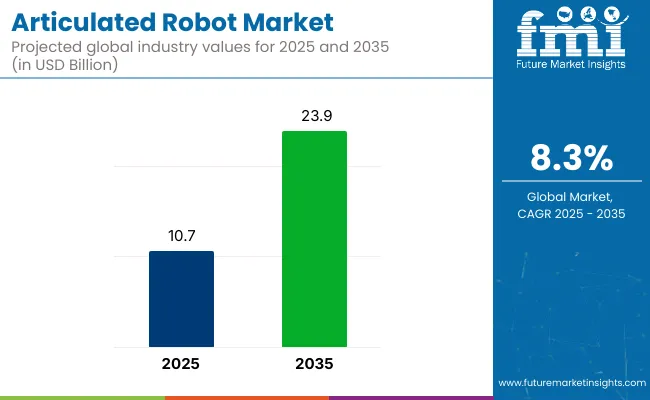
the global articulated robot market is entering a high-growth phase, fueled by rapid advancements in artificial intelligence (AI), Industry 4.0 adoption, and the accelerating need for precision automation across manufacturing ecosystems. According to the latest analysis, the market is projected to grow from USD 10.7 billion in 2025 to USD 23.9 billion by 2035, registering a robust CAGR of 8.3%.
From automotive assembly lines to electronics manufacturing and logistics automation, articulated robots are becoming the backbone of next-generation industrial productivity, enabling scalable, efficient, and intelligent operations worldwide.
Get detailed market forecasts, competitive benchmarking, and pricing trends: https://www.futuremarketinsights.com/reports/sample/rep-gb-17861
Featured Snippet: Key Takeaways
- What is the market size of articulated robots in 2025?
USD 10.7 billion - What is the forecast market size by 2035?
USD 23.9 billion - What is the expected CAGR (2025–2035)?
8.3% - Which region leads the growth?
Asia-Pacific, with Japan growing at 8.7% CAGR - Which segment dominates by type?
6-axis or more robots (50% market share) - Which industry leads adoption?
Automotive sector (40% market share)
Market Overview: Automation Becomes Mission-Critical
The articulated robot market is witnessing sustained expansion as industries prioritize automation, cost optimization, and operational resilience. These robots, known for their flexibility and multi-axis movement, are widely deployed in tasks such as welding, material handling, assembly, and painting.
Their growing relevance is reflected across adjacent markets:
- 10–12% share in industrial automation
- 15–20% share in the broader robotics market
- Increasing penetration in AI-driven and machine vision ecosystems
The convergence of robotics with AI, cloud computing, and IoT is transforming traditional production systems into intelligent, self-optimizing environments.
Key Growth Drivers Shaping the Market
- AI and Machine Learning Integration
Modern articulated robots are increasingly powered by AI algorithms, enabling real-time decision-making, predictive maintenance, and adaptive learning.
- Rising Demand for Industrial Automation
Industries such as automotive, electronics, and aerospace are accelerating automation to enhance precision, throughput, and safety.
- Growth of Collaborative Robots (Cobots)
Cobots are redefining human-machine interaction, allowing robots to work safely alongside humans, expanding use cases across SMEs and flexible manufacturing.
- Industry 4.0 and Smart Factories
Digital transformation initiatives are driving adoption of connected robotics systems, integrated with digital twins and cloud-based analytics.
Segment Analysis: Investment Hotspots
By Type: 6-Axis Robots Lead with 50% Share
Highly flexible and precise, 6-axis robots dominate applications requiring complex motion and high accuracy, especially in automotive and aerospace sectors.
By Payload: Up to 16 Kg Segment Holds 40%
Light payload robots are widely used in electronics and medical device assembly, offering cost-effective automation for small-scale operations.
By Function: Handling Robots Capture 45%
Material handling remains the largest application, driven by demand in logistics, packaging, and warehouse automation.
By Component: Controllers Account for 35%
Controllers are the “brain” of robotic systems, integrating AI, IoT, and real-time analytics for enhanced performance.
By End-Use: Automotive Sector Dominates with 40%
The automotive industry continues to lead, leveraging robots for welding, painting, assembly, and material handling at scale.
Regional Insights: Asia-Pacific Leads, Japan Sets the Pace
- Asia-Pacific remains the largest and fastest-growing region
- Japan leads globally with an 8.7% CAGR, driven by robotics innovation
- Germany (7.8%) and USA (7.5%) follow, supported by strong manufacturing ecosystems
- UK (7.2%) and France (7.4%) benefit from sustainability-driven automation and aerospace demand
The regional landscape reflects a shift toward high-precision manufacturing and smart industrial infrastructure.
Emerging Trends Transforming the Industry
- Adoption of digital twin simulations for process optimization
- Expansion of robotics into healthcare, logistics, and e-commerce
- Development of energy-efficient and sustainable robotic systems
- Integration of AI-driven predictive maintenance
- Increased use of cloud robotics and remote monitoring
Market Challenges to Watch
- High upfront investment costs, particularly for SMEs
- Concerns around workforce displacement and skill gaps
- Supply chain disruptions impacting availability of critical components
- Complexity in integrating robotics with legacy systems
Competitive Landscape: Innovation Defines Leadership
The articulated robot market is moderately consolidated, with leading players focusing on AI-enabled automation, intelligent software, and system integration.
Key Companies:
- ABB Ltd.
- Fanuc Corporation
- KUKA Aktiengesellschaft
- Mitsubishi Electric Corporation
- Denso Wave Incorporated
These companies are investing heavily in:
- Collaborative robots (cobots)
- Energy-efficient systems
- Real-time defect detection and quality control
- IoT and RFID-enabled smart manufacturing solutions
Future Outlook: Toward Autonomous, Intelligent Factories
The next decade will see articulated robots evolve into fully autonomous, AI-driven systems, capable of self-learning and real-time optimization. As industries embrace sustainability and digitalization, robots with lower energy consumption and higher adaptability will become essential.
The fusion of AI, machine learning, and cloud robotics will unlock new levels of productivity, positioning articulated robots at the center of the global industrial transformation.

 English
 Arabic
 French
 Spanish
 Portuguese
 Deutsch
 Turkish
 Dutch
Dutch
 Russian
 Romaian
 Portuguese (Brazil)
 Tiếng Việt